October 20, 2026 - 284 views
Janet Finch-Saunders has criticised the Home Office’s response to concerns about two properties in Llandudno being considered for asylum dispersal accommodation.
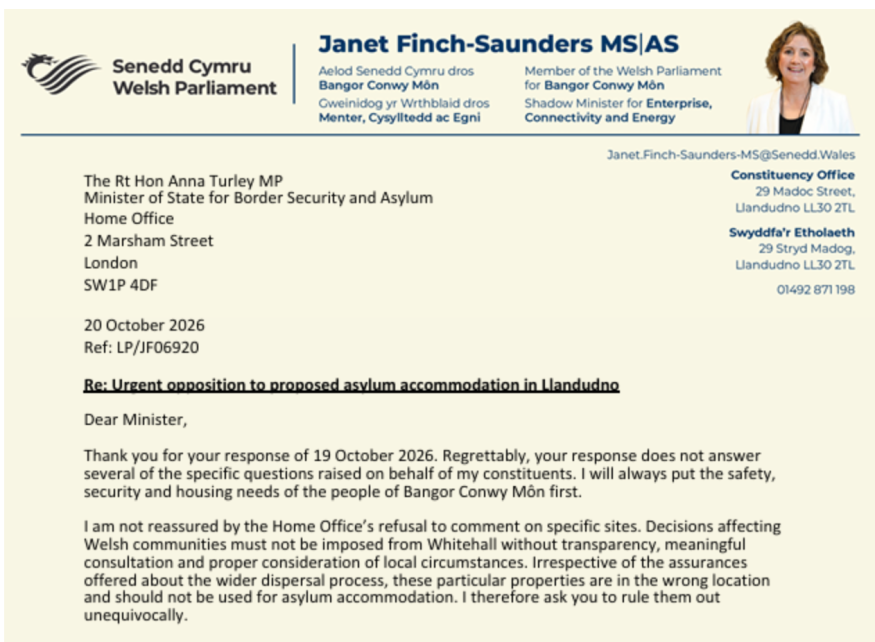
The Member of the Senedd has written to Anna Turley MP, the Minister of State for Border Security and Asylum, opposing the proposed use of the properties.
In her reply, the minister said decisions on dispersed accommodation were guided by Asylum Accommodation Plans, which consider factors including access to local services and social cohesion.
She also said local authority officials were consulted before each dispersal property was procured, including those within Conwy County Borough Council’s area.
However, Mrs Finch-Saunders said the response had not addressed her concerns about transparency or the potential impact on local communities.
“I am not reassured by the Home Office’s refusal to comment on specific sites. Decisions affecting Welsh communities must not be imposed from Whitehall without transparency,” she said.
She added: “While the United Kingdom must remain compassionate, we must consider our families and vulnerable residents across North Wales, who are facing acute housing shortages, homelessness and lengthy waits for suitable accommodation. Their needs must not be treated as secondary.”
Under the UK’s asylum dispersal system, the Home Office is responsible for arranging accommodation for eligible asylum seekers who would otherwise be destitute while their claims are considered. The aim is to distribute accommodation across local authority areas rather than concentrating the responsibility in a small number of places.
Conwy County Borough Council has previously confirmed that accommodation providers had asked it to consider four flats in the Llandudno area for families. In a statement published in December 2025, the council said the properties would be renovated and refurbished by the provider, Clearsprings Ready Homes, if taken forward.
The council has also explained that the Home Office makes the final decisions on asylum accommodation, while local authorities are consulted and can raise concerns about local circumstances. The consultation process does not necessarily mean a council has the power to veto a proposed property.
Home Office guidance says accommodation plans take account of factors such as housing availability, homelessness and access to services, alongside community cohesion. The department has also said details of individual properties are generally not made public before occupation, citing the safety and privacy of people being accommodated.
It is not clear from the minister’s letter whether the two properties raised by Mrs Finch-Saunders have been finally approved for use, or when they might be occupied.
The Home Office has a statutory responsibility to provide accommodation for eligible asylum seekers, while local authorities and communities may raise concerns about the suitability and local impact of individual proposals.